Antiques are a journey through time, a glimpse into the past, and a connection to our heritage.
HE HE ER XIAN (和合二仙)
He He Er Xian are two Daoist immortals who represent harmony (和,hé) and union (合,hé), especially in marriage. They are often depicted as two laughing twins, one holding a lotus flower (何,hé), the other holding a box (盒,hé). The similar pronunciations are a clever play on words, reinforcing the pair's association with harmony and union.
The pair has often been identified with Hanshan (寒山) and Shide (拾得), two Buddhist monks who lived on Tiantai mountain during the Tang Dynasty. Their transformation from historical figures into He He Er Xian reflects the blending of Buddhist, Daoist, and folk traditions in Chinese culture. During the Qing Dynasty, Emperor Yongzheng officially recognized them as the Gods of Harmony and Good Union, further cementing their place in popular Chinese culture.
Because of their association with harmony and marriage, He He Er Xian has become a cornerstone in wedding customs. Their portraits are often hung in wedding halls and bridal chambers to bless couples with happiness and good fortune.

THE EIGHT IMMORTALS (八仙)
The Eight Immortals (八仙) are a group of figures in Chinese mythology known for their immortality and magical abilities. They also represent different aspects of human nature and reflect the Daoist practice of harmony and balance. While the Eight Immortals are often depicted as a group, each wields their own stories.
Learn more about each immortal below!


张果老
Zhang Guo Lao
A magician who is usually riding a mule or holding a bamboo fish stick.
Zhuang Yuan Hui Fu (状元回府)
Zhuang Yuan (状元) refers to the top scorer of the Imperial Palace Examination (殿试), the highest academic distinction in Imperial China. Achieving this title secured prestigious government positions and brought honor to the scholar. In traditional Chinese art, the Zhuang Yuan is often depicted wearing a scholar's hat and formal robes, highlighting the importance of education and intellectual success in Chinese culture. Bang Yan (榜眼) and Tan Hua (探花), the second and third place finishers, respectively, were also highly respected. Together, these scholars embodied the values of meritocracy, and offered a beacon of hope for upward mobility through academic excellence.

QiLIN (麒麟)
Qilin (麒麟), often referred to as the "Chinese unicorn," is a mythical creature in Chinese culture combining features of various animals, such as the dragon, deer, horse, and ox. Despite its fierce appearance, the Qilin is a gentle and auspicious being, believed to appear only under the rule of a wise and benevolent leader, serving as an omen of peace and prosperity. Associated with peace, justice, virtue, and good fortune, Qilin has become a favored motif in Chinese art, often surrounded by flames to cement its celestial nature. During the Ming and Qing dynasties, high ranking military officials wore embroidered Qilin rank badges (麒麟送子), further emphasizing its symbolism of harmony, authority, and auspicious rule.

Lotus(莲花) and Crane(仙鹤)
The lotus (莲花) is a symbol of purity and elegance. Growing from muddy waters but blooming untainted, it represents integrity and resilience. In Buddhism, the lotus represents wisdom and spiritual enlightenment and is frequently depicted as the throne to Buddhist deities. Additionally, because the word 莲 (lotus) is a homophone for 连 (continuous), it's often associated with auspicious sayings wishing for happiness, prosperity, and a harmonious marriage.
The crane (仙鹤), admired for its gracefulness, is one of the most beloved birds in Chinese culture. It symbolizes longevity and happiness, and is often depicted as the mount of immortals, carrying them between heaven and earth. There is even a saying that cranes are the immortals of animals. Despite inhabiting swamps and wetlands, their white coats remain untainted, further reinforcing their association with purity and auspiciousness.
Together, the lotus and crane form a powerful motif symbolizing a noble and virtuous life. Cranes are known as a first-rank bird, and 莲(lotus) and 廉(integrity) are homophones, so their pairing embodies the ideal of first rank integrity and the wish of a high-ranking position. The purity of the lotus and longevity of the crane symbolize that those with noble characters will enjoy enduring peace and a long life. In art, when cranes are depicted next to a lotus flower, it creates a scene of tranquility and peace, representing the yearning for an ideal and harmonious world.

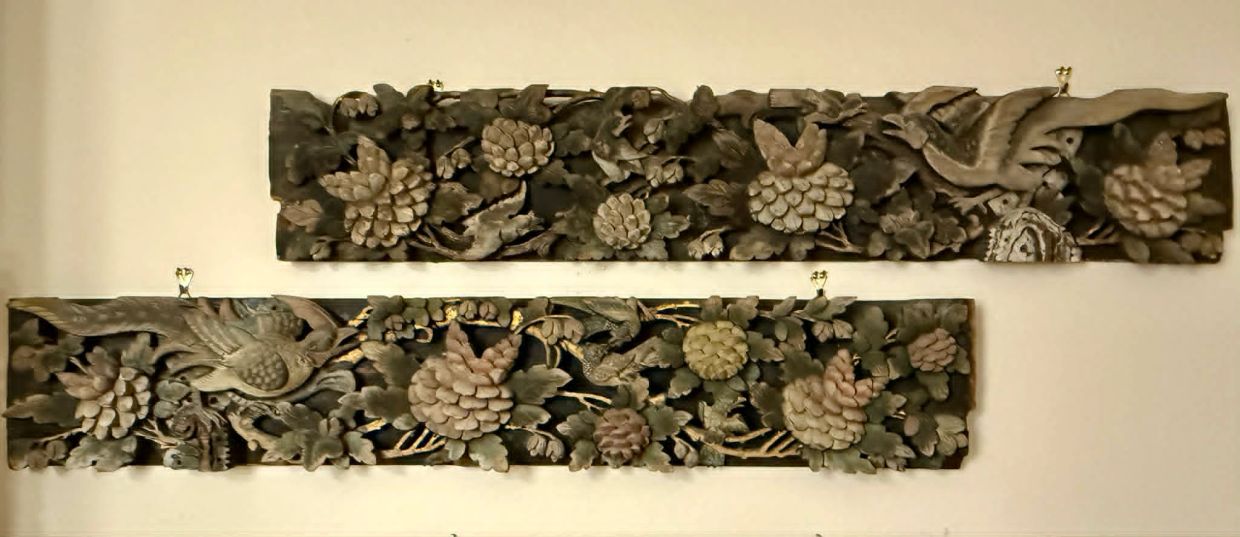
Phoenix among Peonies (凤穿牡丹)
The phoenix ( 风) is one of the most revered mythical creatures in Chinese culture and is associated with nobility, virtue, harmony, and good fortune. Unlike its Western counterpart, the phoenix does not die and get reborn from the ashes. Rather, it is majestic and the specific emblem of the Chinese Empress. It was believed that the phoenix only appeared during times of peace and prosperity, or under a wise or virtuous leader. Its graceful form and association with the empress represent feminine energy and a symbol of beauty, dignity, and auspiciousness in Chinese art.
Known as the "king of flowers," peonies (牡丹) are admired for their lush, overflowing petals and represent wealth, honor, prosperity, and beauty. During the Tang Dynasty, the flower became especially celebrated when emperors planted them in imperial gardens. Because of its beauty and connection to wealth and high status, the peony has become one of the staples in Chinese art.
Together, "Phoenix Among Peonies" (凤穿牡丹) is a motif conveying wishes for happiness, prosperity, and a life of abundance. The phoenix weaving gracefully through flourishing peonies suggests the harmonious coexistence of nobility and wealth, elegance and prosperity. The motif has therefore also become an auspicious expression of wishes for a harmonious marriage and is a popular design for wedding textiles and other objects celebrating a prosperous household.
For inquiries about our cultural collection, please don't hesitate to reach out.
This website uses cookies.
We use cookies to analyze website traffic and optimize your website experience. By accepting our use of cookies, your data will be aggregated with all other user data.